Oakland, California · Bay Area
Camden Boston
R&D Mechanical Systems Engineer
I turn physical requirements into hardware and software. My work spans mechanical design, instrumentation, modeling, and hands-on test development.
Mechanical design · Hardware development · Integration & test
Explore selected engineering work ↓Current work · October 2023–present
Sandia National Laboratories
R&D Systems Engineer - Flight Test Team
Livermore, California
On Sandia’s Flight Test Team, I work with designers, fabricators, technicians, and electrical specialists to develop mechanical and electromechanical hardware. I lead projects from design and fabrication through assembly, physical testing, and stakeholder acceptance.
Separation Shock: Developed novel test methodology and test bed from end to end
I led test development through execution and stakeholder acceptance, including hardware design for a custom pressure-actuation system. For separation shock testing, I selected accelerometers and pressure sensors, configured and operated DAQ, and developed assembly/test processes with the team.
Torque and Angle Signature Logger: Developed instrumentation and software to estimate bolt preload
I designed the mechanical hardware and positioning fixture, integrated a higher-resolution encoder with a COTS torque/angle tool, and worked with the team on a five-point torque calibration. I also developed MATLAB models to estimate bolt preload from loosening measurements, checking predictions against load-cell measurements.
Vertical Pedestal Fixture: Optimized vibration and shock testing performance
I changed a welded configuration to a machined main body, balancing stiffness, mass, height, and installation access. The completed fixture passed dynamic load testing and made test-article installation easier.
Strongback: Designed and load-tested critical fixturing hardware
I designed a below-the-hook lifting device and load-tested it to withstand a 3,500-lb load. I analyzed load paths and pin shear, led drawing creation, made all GD&T decisions, and performed tolerance stack-ups.
Selected hardware · Purdue research and capstone
Design decisions, with the hardware.
Two earlier projects show my mechanical design and integration work in detail. Dates, team roles, and demonstrated hardware results stay visible.
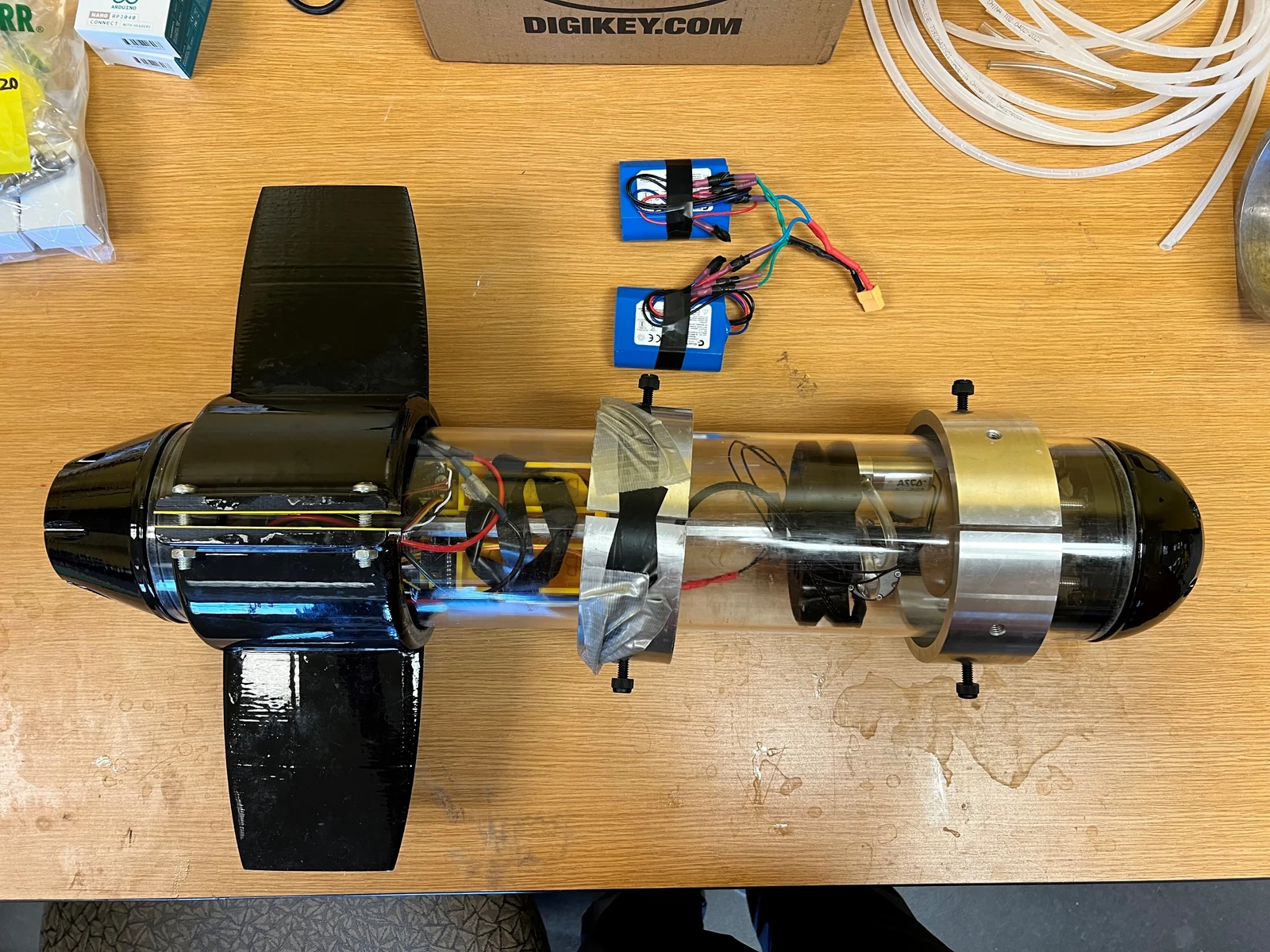
mini-ROUGHIE Underwater Glider
I redesigned and built a smaller underwater research platform, replacing a bulky pitch mechanism with a commercial actuator and integrating ballast, movable mass, and a command interface.
Individual redesign within Mahmoudian Lab research · 2022–2023
Pool-tested hardware; software coordination remained in development.
Read the case study →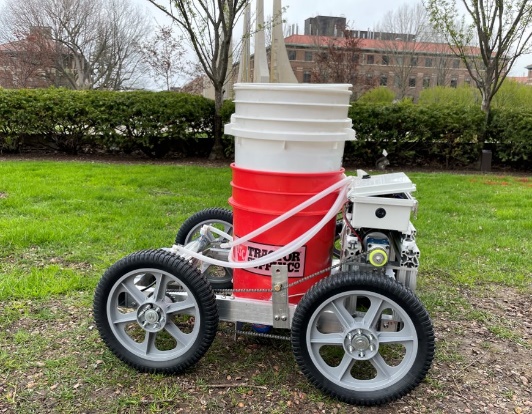
Camel Bots
Our printed belt transmission slipped during skid steering. The team moved to metal sprockets, chain, supported hubs, and bearings. I led project coordination and systems integration.
Project manager & chief engineer · Five-person team · 2022
Human-operated travel demonstrated; water-treatment safety not established.
Read the case study →Browse the project archive: controls, drives, and robot integration →
Independent digital studies · 2026
Explore the models.
Interactive simulations with visible assumptions, numerical checks, and downloadable source. These are digital studies, without hardware validation.
Compare system order, define an ODE of order 1–8, and tune PID, pole placement, or LQR. Explore a reduced rover velocity model with four controller comparisons.
Open lab →Rover velocity study →Compare nonlinear and linearized pendulum motion at a hard stop. Change rebound and geometry, inspect contact events, and export a run.
Open lab →Methods · PDF →Choose a goal and compare path planning and obstacle avoidance. The model uses known-pose mapping; it does not run ROS or full SLAM.
Open lab →Compare PID, state feedback, and LQR on one two-state motor model. Inspect voltage saturation, current, response, and control effort.
Open lab →Technical note · PDF →Project archive · Purdue University, 2021–2023
Further hardware and modeling studies.
University team projects and individual studies, with later digital reconstructions identified separately.
A cart balances an upright rod after small pushes and loses balance after a larger disturbance. A later nonlinear reference makes the sensing, feedback and recovery limits inspectable.
2021 hardware · separate 2026 reference
Purdue project team · individual subsystem ownership not established
Original hardware footage · later digital reference
An eighteen-state rover model connected motor currents, wheel slip, chassis heave and pitch. The useful result was understanding which control decisions the model could support and where its assumptions failed.
2022 · Purdue study; separate 2026 correction
Individual model integration and controller comparison
Historical simulation · later eighteen-state digital extension
A rotary-table controller, a frozen feedback cable, and a new sampled model that makes the sensing and timing assumptions explicit.
Fall 2021 · Digital reconstruction, 2026
Purdue team project · Boston, Chavan, Hall; subsystem ownership not established
Historical team hardware demonstration · separate 2026 simulation
A four-wheel mecanum robot used one reversible drum to collect and launch a ball. Power integrity and repeatable calibration determined the final result.
December 2022 · Digital reconstruction 2026
Five-person Purdue project team · subsystem ownership not established
Historical practice functions demonstrated; final demo scored no points. Separate 2026 digital reconstruction.
A permanent-magnet AC drive study connects current selection to torque, voltage limits, and a checked power balance.
April 2023 · Purdue study; numerical extension October 2026
Individual simulation study; later numerical implementation
Historical switching simulation · separate averaged numerical model
Earlier experience & education
Purdue · Mahmoudian Lab, 2022–2023. Underwater-glider redesign, C++ communication with a microcontroller, and an HTML command interface. Research case →
Purdue Lunabotics, 2018–2022. Chief engineer, 2020–2021. Helped lead the team and sized drivetrain and linear actuators.
General Motors, 2020 & 2021 internships. MATLAB drive-cycle analysis and Cadillac EV integration design across studio and engineering teams.
Purdue Mechanical Engineering. M.S., May 2023 · B.S., May 2022.