Independent simulation project · 2026

Impact Dynamics Lab.

A smooth swing. A sudden impact.
Explore when a simpler model is good enough.

A pendulum bob meets a mechanical stop.
Change the geometry and rebound, then watch the two models separate.

Run the experiment

Runs in your browser · no MATLAB required

Loading the simulation…
Start with a question
−60°60°

Zero is vertical. The stop cannot pass the release position.

Less reboundElastic
10°110°

Sliders compare the same release at the current time. The wall stays fixed during each simulated run.

Full sine flightLinearized flightBoth include impacts ↘
01 / Mechanical motionFree flight
Pendulum bob and adjustable mechanical stopBlue shows the full sine model; the dashed rust-colored rod shows the linearized model. The wall is offset from the bob center by its schematic radius.verticalSTOPθ = 90°Rod length: 0.50 m
02 / Phase portraitPosition + velocity
Phase portrait of the two impact modelsHorizontal angle and vertical angular speed show continuous flight arcs connected by instantaneous vertical jumps at the stop. Dots show the current states.Angle θ (deg)Angular velocity ω (rad/s)
Scrub to inspect a collision. The full phase paths show the complete run.
First impact · full sine—
Linearized arrival difference—
Impact kinetic energy retained90.3%

Before vertical: rebounds approach supported contact.

The engineering question

How much model
does the decision need?

A linkage reaching a travel limit must redirect motion and dissipate energy. Stop angle and rebound affect when it strikes, how fast it arrives, and what happens afterward.

This one-degree-of-freedom mechanism isolates those effects. It is relevant to mechanical end stops, passive linkages, and impact-aware robot motion. A particular robot joint still needs its own inertia, actuator torque, friction, and contact geometry.

0.19% → 15.28%

Free-period underprediction grows from a 10° release to a 90° release when sin θ is replaced by θ. The reference is the full sine model, not a physical measurement.

At small angles, the simpler model may meet the required error budget and is easier to analyze and use in control design. At large angles, it predicts too much restoring torque; arrival time and impact speed shift. Nonlinear models are established engineering tools. Their extra detail pays off when it changes the decision and the required parameters can be identified.

For the default 90° release and 15° stop, the predicted first collision shifts by about 60 ms between the two models. That can matter when a mechanism’s actions depend on event timing.
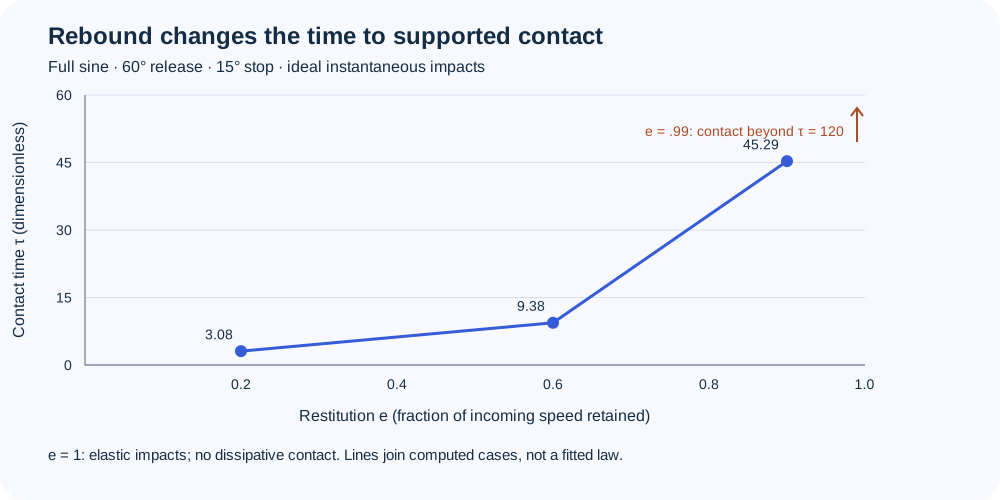
Rebound controls the time to contact.

A new 50-case study varies stop angle and restitution in both flight models. For a 60° release and 15° stop, full-sine contact time grows from 3.08τ at e = 0.2 to 45.29τ at e = 0.9. At e = 0.99, contact is bounded beyond the 120τ study window; at e = 1, there is no dissipative contact.

Computed full-sine contact time rises with restitution; the near-elastic case lies beyond the study window.
New numerical sensitivity study. The plotted line joins computed cases. All 50 cases · CSV · Checks and bounds

The sampled-run CSV follows the displayed trajectory. The separate impacts CSV preserves exact incoming and outgoing states, energy loss and normal impulse. Physical energy and impulse assume a 0.050 kg point mass and 0.50 m rod under 9.81 m/s² gravity; they are predictions, not measured contact forces. Event counts omit the unresolved microscopic rebounds represented by a bounded positive-stop tail.

The model: smooth flight, sudden contact

Full sine: θ″ + sin θ = 0
Linearized flight: θ″ + θ = 0
Impact: v⁺ = −e v⁻ at θ = α

Primes use dimensionless time τ = √(g/L)t; v = dθ/dτ. The display converts to seconds and rad/s using an assumed L = 0.50 m and g = 9.81 m/s².

Both complete models are hybrid systems. Their collision times depend on the state, and velocity jumps at impact. Only one flight equation is linearized. The impact law retains a fraction e² of the incoming kinetic energy.

A positive stop angle can lead to finite-time impact accumulation and supported contact. At zero, decay is asymptotic. Beyond vertical, repeated impacts approach a grazing oscillation; some low-energy releases never reach that stop.

Verification, assumptions, and limits

The browser implementation is checked against reference trajectories exported from the independently verified MATLAB model. The downloadable source includes tests and reference data.

Checks cover collision timing, the velocity reset, conservation between impacts, nonpenetration, nearly elastic rebound, and positive, zero, and negative stop angles.

Open the browser validation summary ↗

Point mass, light rigid rod, frictionless pivot, fixed rigid stop, instantaneous contact, and constant restitution. The drawn bob radius is schematic. Continuous rotations, material deformation, and contact-force peaks are outside this model.

Microscopic positive-wall rebounds use a bounded numerical tail. This is numerical verification, not experimental validation. No hardware measurements or prototype results are presented.

The next experiment

Build a small pendulum and adjustable stop. Measure geometry, use free swings to estimate losses, and track pre- and post-impact speeds to estimate restitution. Record repeated trials and measurement uncertainty.

Fit parameters on one set of trials, then predict separate release and stop angles. Compare arrival time, rebound height, and energy loss. Add contact compliance or speed-dependent restitution only when the measurements justify it.

Methods, evidence, and next steps

Explore the work
behind the motion.

The accompanying case study connects the model to an engineering decision, quantifies approximation error, and lays out a physical validation plan.

Camden Boston · Independent redevelopment, 2026. Extends Camden Boston’s 2021 pendulum-impact analysis at Purdue with event-resolved simulation, model comparison, numerical verification, and interactive interfaces.

References: MIT: The Simple Pendulum · MathWorks: Linearization · MathWorks: Rotational Hard Stop