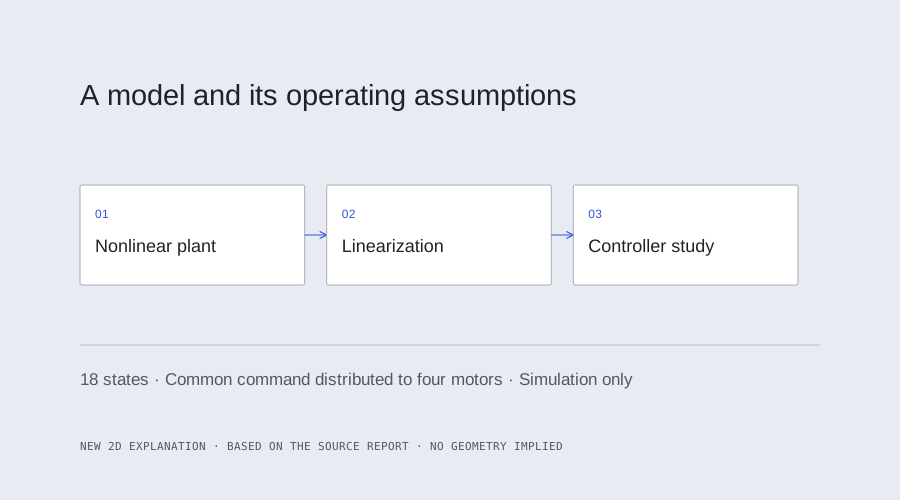
Keep the input architecture visible
The historical plant had eighteen states but used one voltage command replicated across all four motors. That arrangement can control forward speed, but it cannot independently correct every wheel difference. The later model keeps the shared command for the velocity comparisons and exposes four independent voltage inputs as a separate diagnostic option.
Correct the model before ranking controllers
The source report and setup disagree on mass and several soil parameters, and the original rank calculations did not establish controllability or observability. The 2026 model selects a stated 36.54 kg baseline, includes 100 kg as a separate sensitivity, and uses the complete plant matrices for its diagnostics. It also replaces an unfinished contact calculation with a defined pressure distribution, finite signed traction and passive motor losses.
Retain the coupled dynamics
The new plant retains chassis translation, heave and pitch, four relative wheel angles and speeds, and four motor currents. Wheel acceleration includes carrier pitch motion, and motor reaction torque acts on the chassis. An independent mechanical power balance checks these interfaces. The force closure is a specified approximation; it is not calibrated soil behavior.
Compare the same task under the same limits
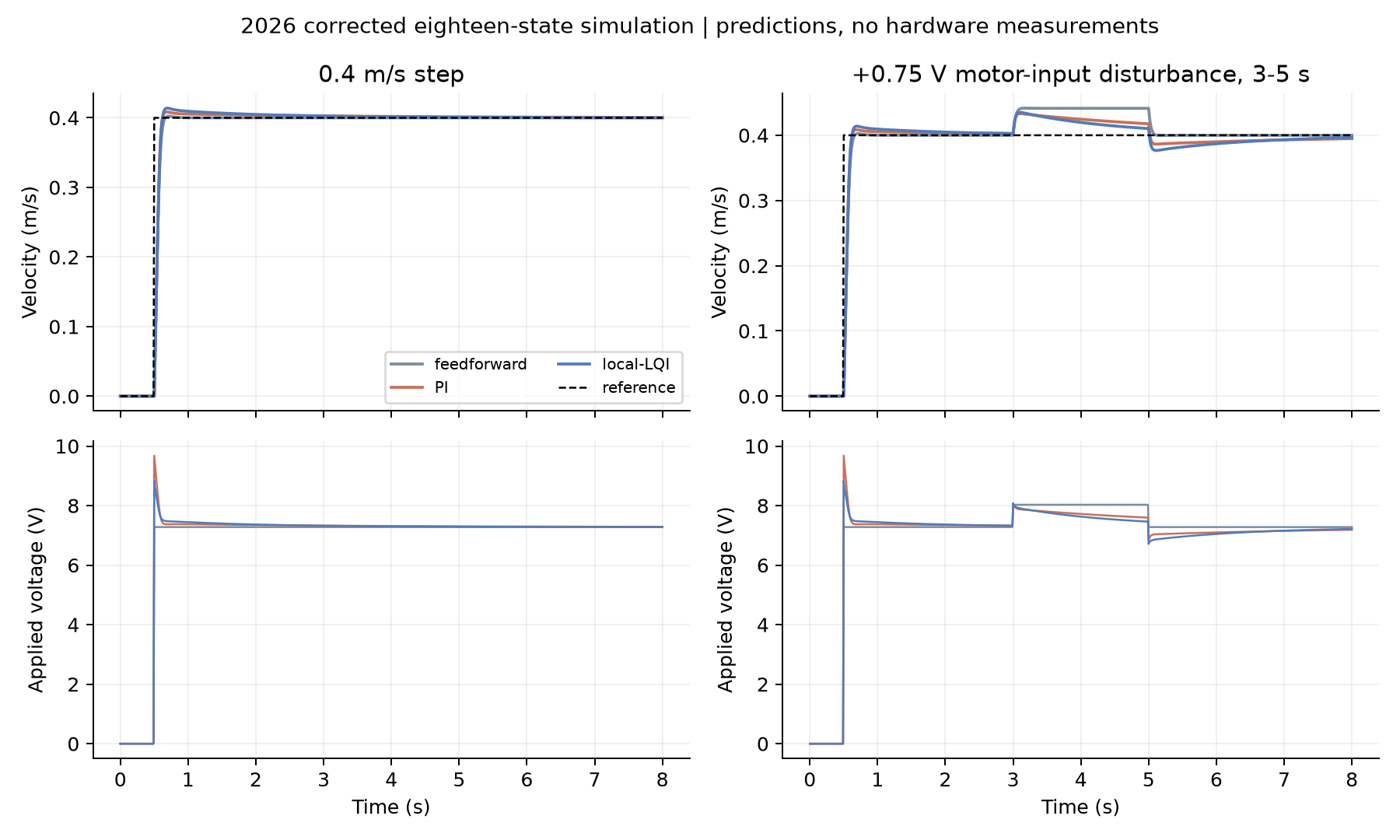
Feedforward, PI and local integral state feedback run against the same complete nonlinear plant, initial conditions and ±12 V voltage bound. The comparisons separate step, ramp, sinusoidal and seeded noisy references from an independent motor-input voltage disturbance. Both regulated cases finish the nominal 0.4 m/s step within 0.001 m/s, while their disturbance recovery and transient behavior differ.
Show the operating boundary
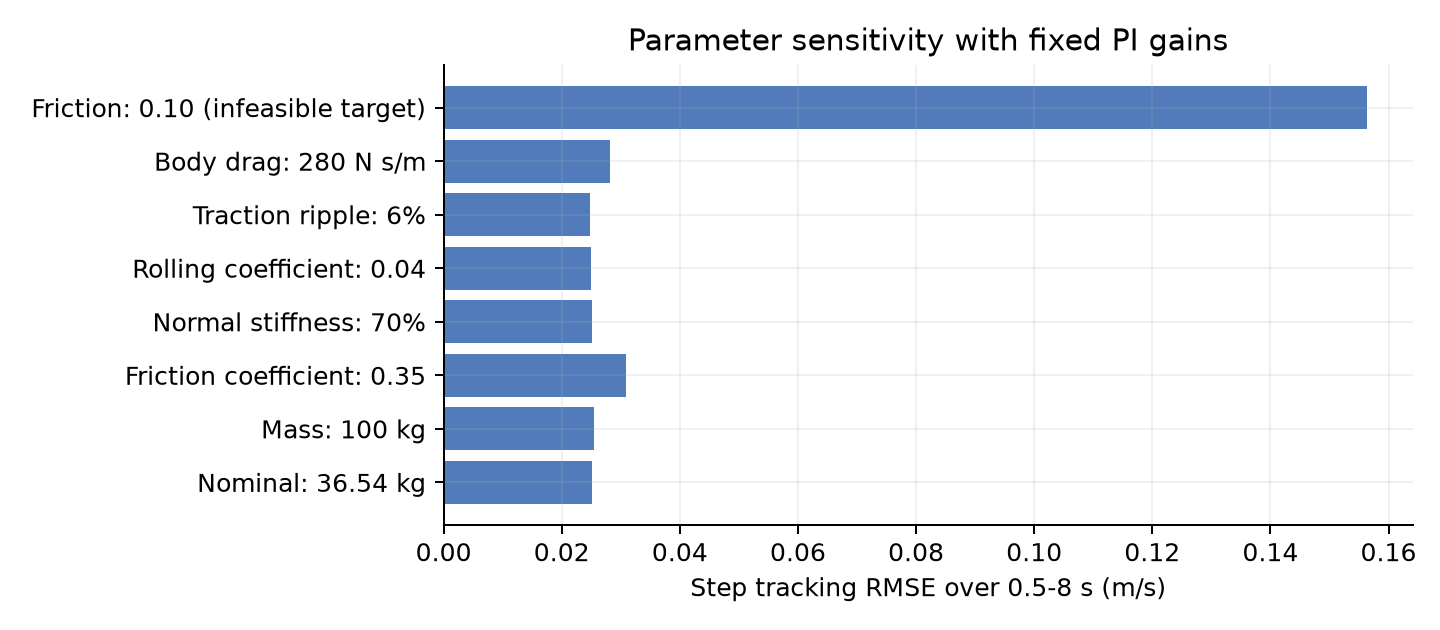
The low-traction sensitivity cannot reach 0.4 m/s: its available traction is about 35.8 N against 56 N of modeled drag at that speed. PI saturates and retains about 0.144 m/s of error. The equilibrium calculation rejects the same target. That result identifies a force limit that controller tuning cannot remove.
Use the result at the right scale
The package contains reproducible source, full-state traces, parameter provenance, solver comparisons and 42 reference, energy, diagnostic and failure checks. Algebraic observability remains poorly conditioned in one velocity-only mode, and state feedback uses ideal simulated signals. The corrected model supports a bounded digital comparison; physical motor, sensing and terrain identification remain unperformed.
2026 eighteen-state simulation
2026 operating-boundary check
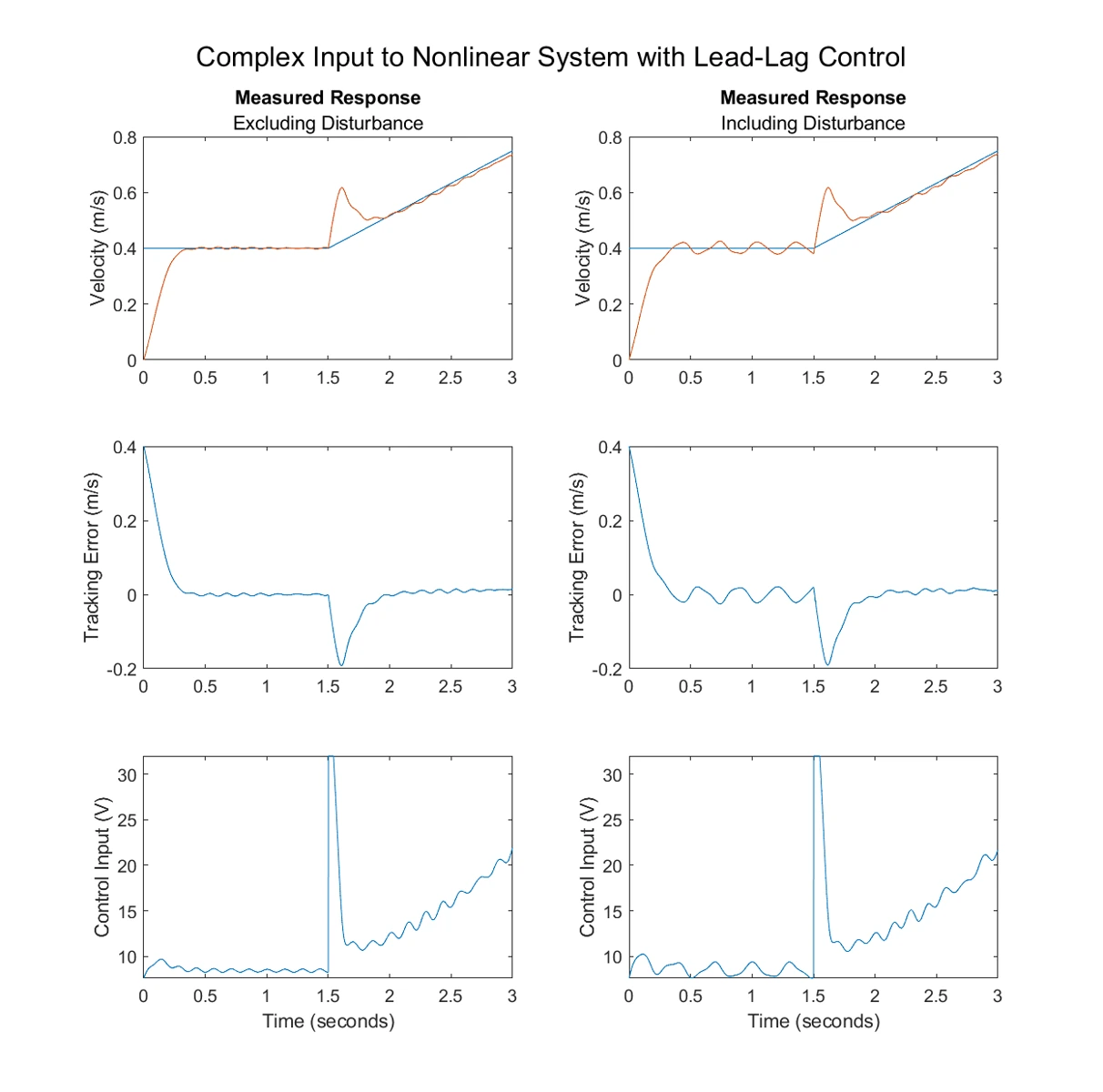
Two historical simulation cases
These original plots show selected-case tracking and a failed noisy-reference case. The original label “Measured Response” denotes simulated plant output. No physical measurements are shown.
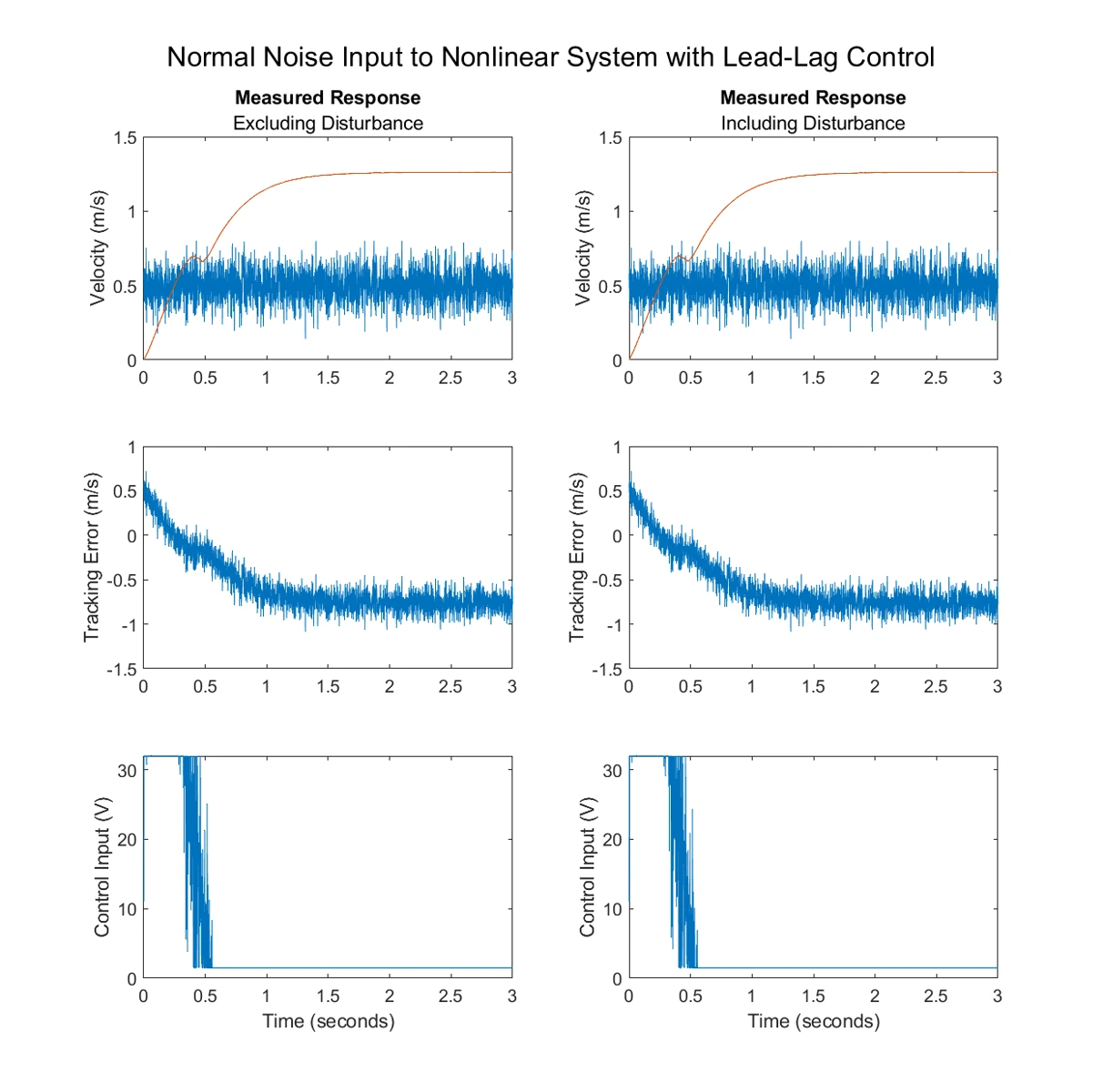
Historical simulation is evidence of the study. A new demonstration is a separate artifact.
Explore the revised velocity-tracking experiment →Project context
Camden Boston, original 2022 simulation analysis. The separately identified 2026 digital correction does not establish new hardware or terrain measurements.
Historical photographs, footage, and plots retain their original dates. Later digital reconstructions are identified separately; their numerical checks do not establish hardware performance.