Select current from the torque constraint
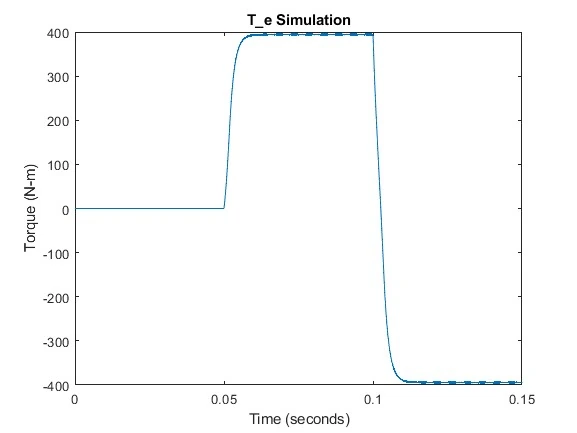
I modeled a permanent-magnet AC drive in MATLAB/Simulink, generated d- and q-axis current lookup tables, and compared the switching simulation with steady-state torque and power calculations. The machine uses eight poles, with a fixed mechanical speed of 500 rpm in the historical study. At the ±400 N·m reference point, the steady calculation requires about 222.35 A phase peak.
Resolve what the original check leaves open
The saved optimizer minimizes current under torque equality, but does not enforce the declared current maximum or an inverter voltage limit. The reported switching simulation reaches approximately ±394.3 N·m for ±400 N·m requests. A later analytical check shows that the displayed proportional current regulator predicts that offset with finite stator resistance; it is not evidence of measured motor losses.
Define the achievable operating envelope
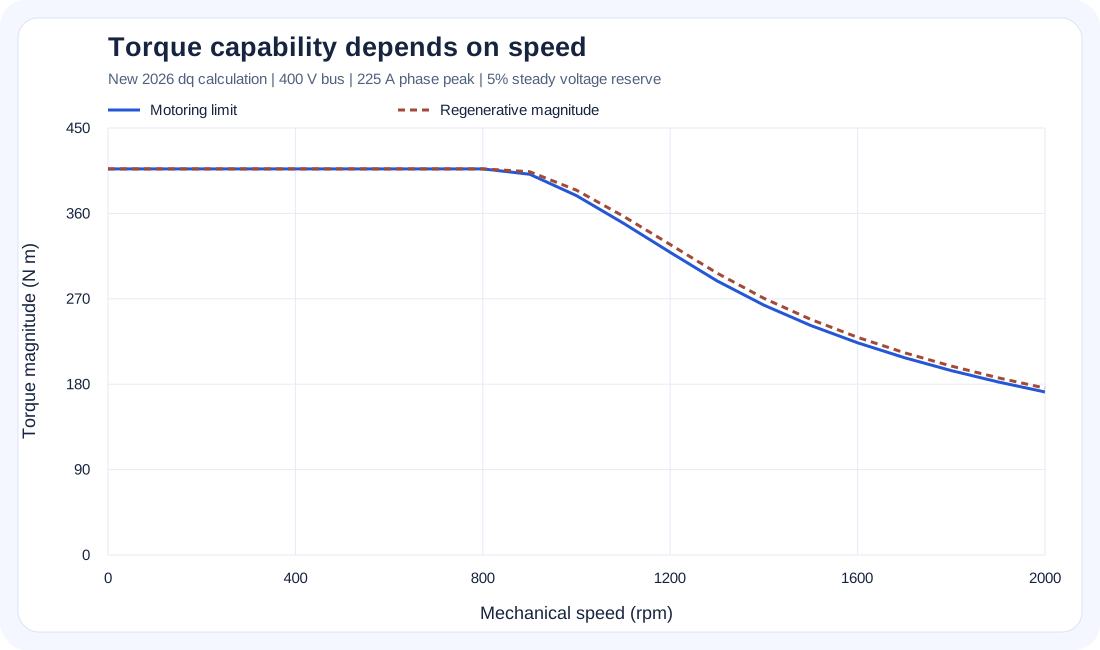
The separate 2026 model adds explicit current and voltage constraints, a complete speed–torque map, and a guarded lookup interface. With the same illustrative motor values, a 400 V bus, a 225 A phase-peak limit, and 5% steady voltage reserve, +400 N·m is feasible at 500 rpm. At 2000 rpm, the positive torque limit falls to about 171.80 N·m. Infeasible requests return a bounded target with a saturation status.
Check the model and its limits
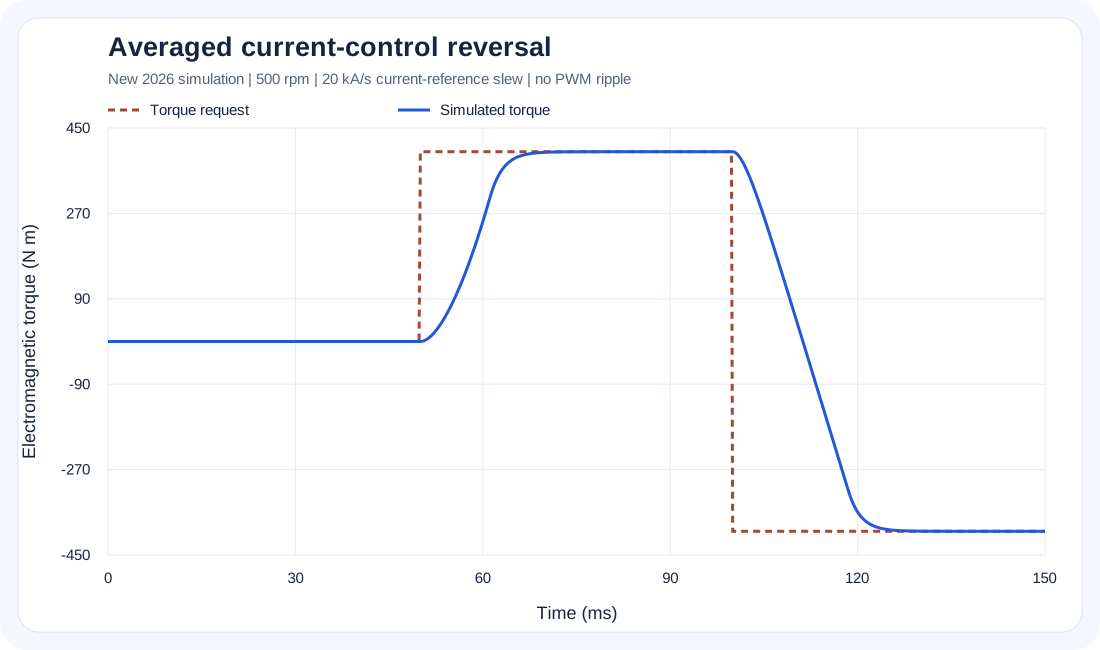
The new averaged model is checked against exhaustive current searches, a separate voltage-boundary calculation, phase and power identities, time-step refinement, and parameter sensitivity. Its slew-limited PI current controller follows the 0 → +400 → −400 N·m sequence at 500 rpm while staying within the stated current and voltage limits. These are reproducible numerical results. Switching ripple, battery dynamics, thermal behavior, firmware, and physical validation remain outside this model.
2026 calculated operating envelope
2026 averaged current-control response
Project context
Camden Boston's individual April 2023 simulation study used supplied model material and numerical methods. The 2026 implementation is a separate numerical extension. No motor hardware measurements are claimed.
Historical photographs, footage, and plots retain their original dates. Later digital reconstructions are identified separately; their numerical checks do not establish hardware performance.