The motion dictated the wheel type
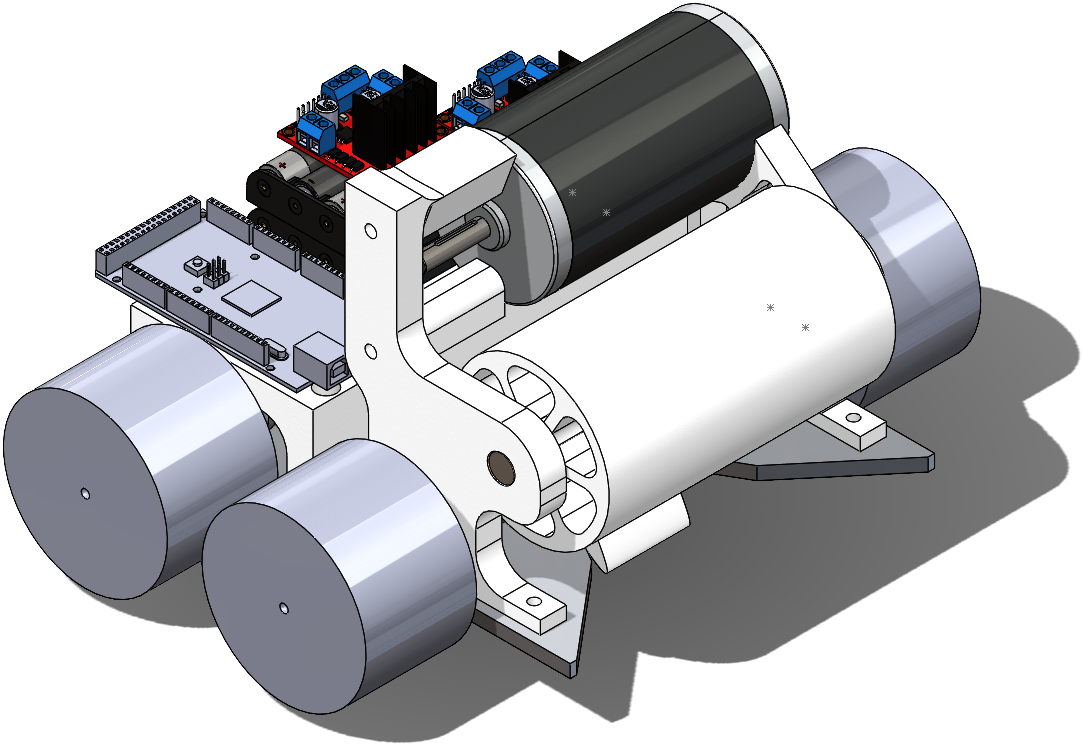
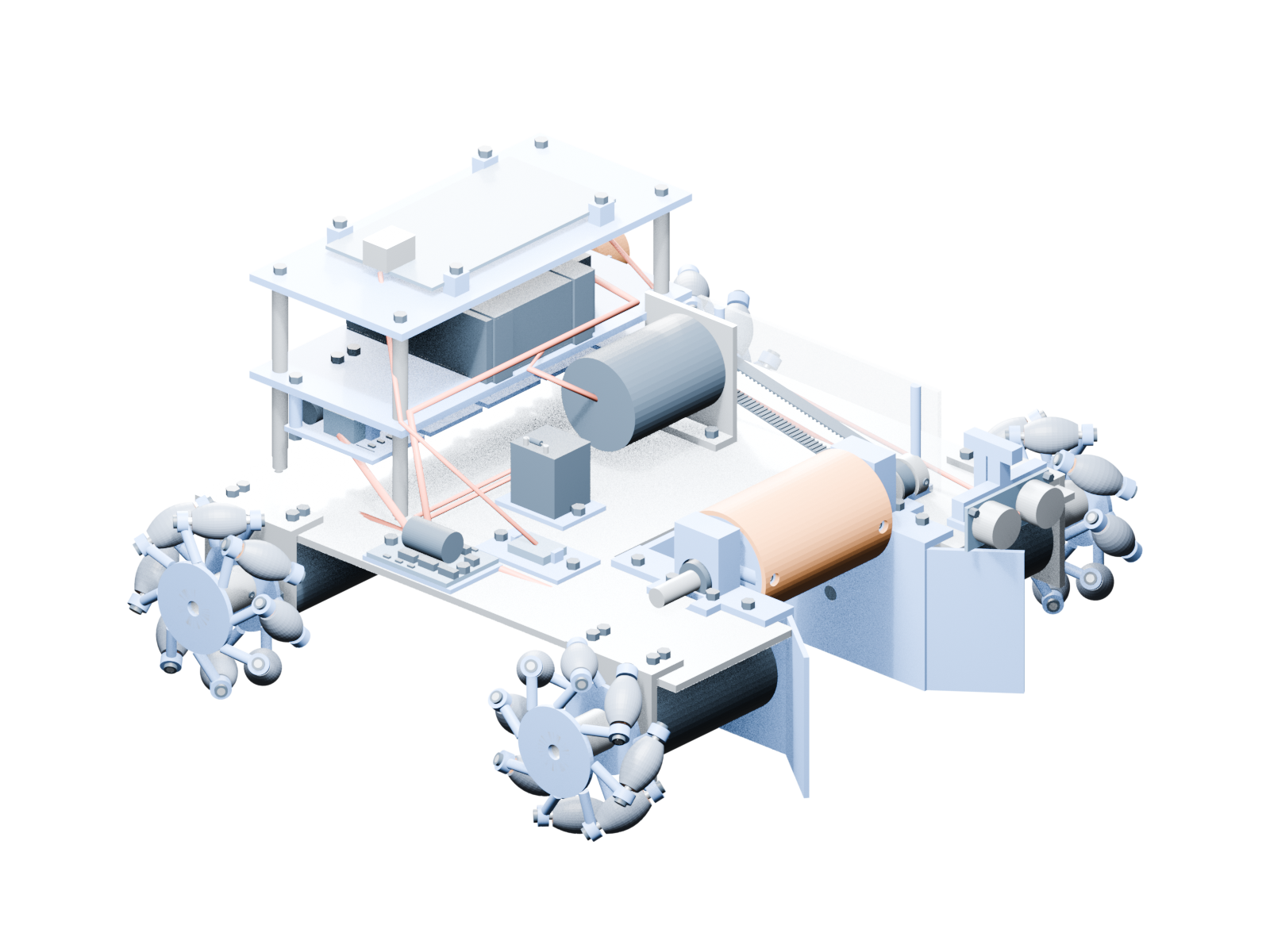
We selected four mecanum wheels so the robot could translate sideways while staying aimed toward the goal. Each wheel uses passive rollers at an angle to its plane. Diagonal wheel pairs reverse together to produce lateral motion. The original CAD image simplified those wheels to cylinders; the later reconstruction models both roller hands, their axles and the motor interfaces.
One drum, two functions
A reversible compression drum collected the compliant ball in one direction and expelled it in the other. The historical rubber-band transmission slipped under load and was damaged by the motor shaft. The new digital assembly replaces that transmission with a defined timing belt, supported drum shaft, bearings and a guard. Its dimensions and components are later engineering selections, with physical launch performance still unverified.
A control tradeoff under a deadline
The team used individually calibrated open-loop wheel commands after multi-motor PID integration proved unreliable. Encoder thresholds advanced the task sequence, and ultrasonic sensing detected the ball. Later work operated four-motor PID, but tuning remained incomplete. The final configuration therefore depended on fresh calibration and battery condition.
What the final demonstration established
Practice runs found, collected, repositioned and shot the ball. Immediately before the final demonstration, a battery connector came unsoldered. Repair consumed the calibration opportunity, unwanted rotation affected the sequence, and the robot scored no points. That outcome makes the power connection and calibration process central to the engineering story.
The later digital reconstruction
The new package defines an actual roller-wheel assembly, ball corridor, geared drum drive, fused power path and point-to-point interfaces. A separate controller reference gives every wheel its own PI state and adds debounced sensing, timing checks and latched faults. Its verification covers the normal sequence, stale and future sensor data, a single stalled or reversed encoder, power faults and failed collection or launch. These are numerical and digital assembly checks; they do not establish a newly built or experimentally validated robot.
2026 Blender reconstruction
Project context
Original robot: Anshul Agarwal, Camden Boston, Rohit Daithankar, Elliott Schmittenberg and Chutipol Thamaratnothai, December 2022. Individual subsystem ownership is not inferred from team membership. The 2026 reconstruction is separate work.
Historical photographs, footage, and plots retain their original dates. Later digital reconstructions are identified separately; their numerical checks do not establish hardware performance.