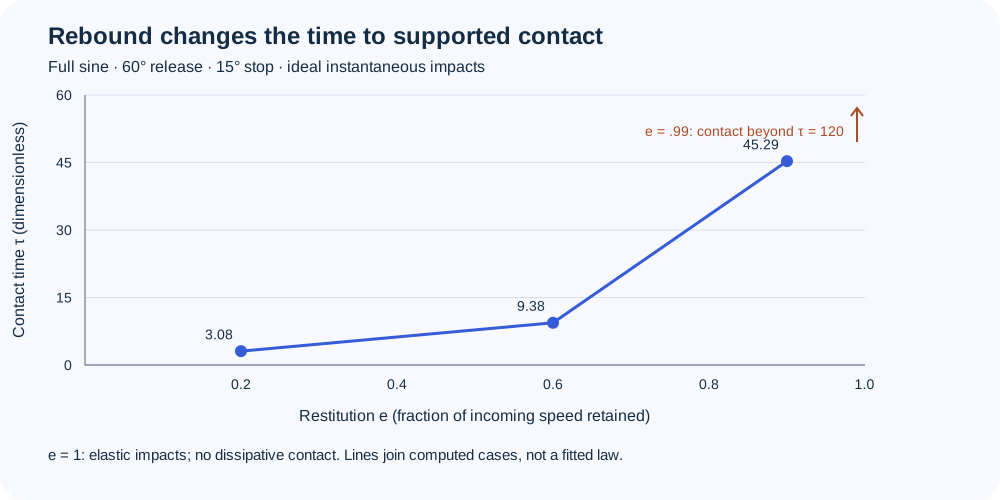
A linkage reaching a travel limit must redirect motion and dissipate energy. Stop angle and rebound affect when it strikes, how fast it arrives, and what happens afterward.
This one-degree-of-freedom mechanism isolates those effects. It is relevant to mechanical end stops, passive linkages, and impact-aware robot motion. A particular robot joint still needs its own inertia, actuator torque, friction, and contact geometry.
Free-period underprediction grows from a 10° release to a 90° release when sin θ is replaced by θ. The reference is the full sine model, not a physical measurement.
At small angles, the simpler model may meet the required error budget and is easier to analyze and use in control design. At large angles, it predicts too much restoring torque; arrival time and impact speed shift. Nonlinear models are established engineering tools. Their extra detail pays off when it changes the decision and the required parameters can be identified.
For the default 90° release and 15° stop, the predicted first collision shifts by about 60 ms between the two models. That can matter when a mechanism’s actions depend on event timing.