Start with the load path
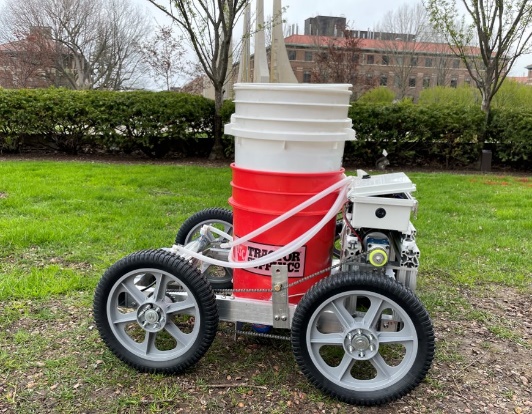
Turning a four-wheel skid-steer platform demands more torque than straight travel because the tires must scrub sideways. Our printed belt sprocket could not maintain engagement during turns. Slip generated heat that deformed the tooth pattern and made engagement worse. We changed to aluminum sprockets and chain, metal hubs and additional bearings. I served as project manager and chief engineer; teammates led CAD, programming and electrical work, analysis, and manufacturing and validation.
What the prototype actually demonstrated
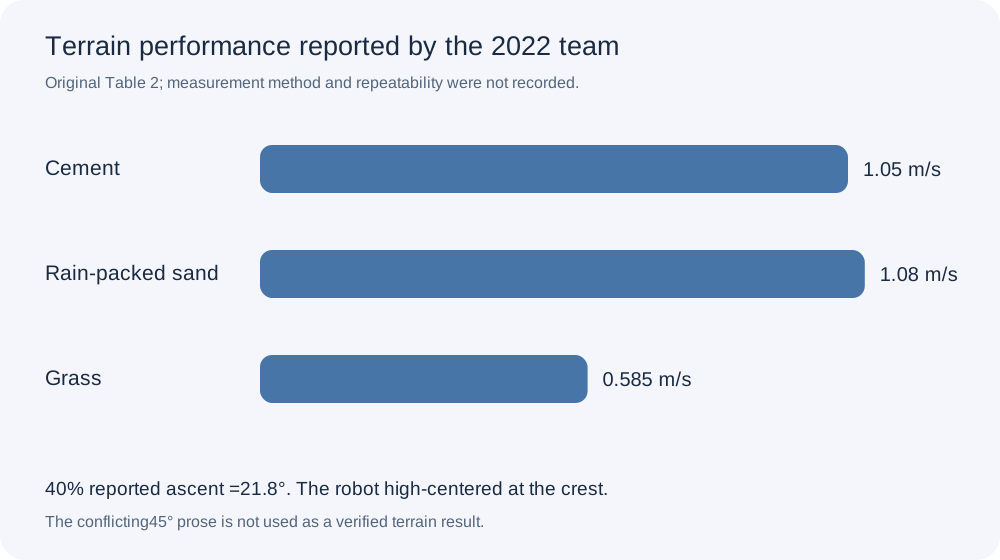
The final prototype used Bluetooth remote control with front ultrasonic sensing to inhibit forward travel near an obstacle. It required a human operator. The report records speeds of 1.05 m/s on cement, 1.08 m/s on sand and 0.585 m/s on grass. The sand had been packed by recent rain. The team reported a 40% grade ascent, equivalent to 21.8 degrees, followed by high-centering at the crest. Conflicting 45-degree prose is not treated as a verified capability.
Power and water handling were system constraints
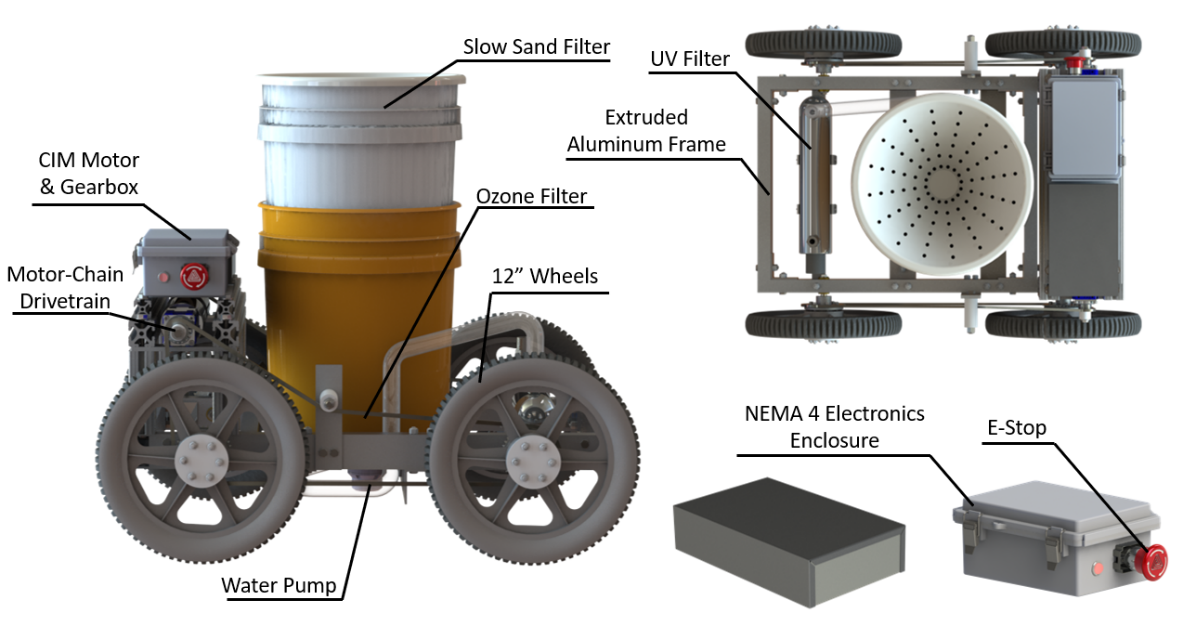
The prototype used a 12 V, 5 Ah battery, while its UV equipment required an AC outlet. Turning also exposed motor-current peaks that opened the original fuses and drove controller, wiring and enclosure changes. GPS, lidar, a larger battery and fully self-contained treatment belonged to the proposed product. The small water-sample study did not establish potability or biological safety.
A separate digital reconstruction closes the design interfaces
A separate 2026 digital reconstruction defines a non-potable transfer configuration around a 65 kg gross limit, 20 L combined payload and 0.25 m/s speed limit. The design package includes a 65-row BOM, supported chain drivetrain, tank restraints, fluid and power interfaces, and original supervisory software with simulated hardware inputs. At the selected 20% grade, the model predicts 19.8 A per motor and 216.9 Wh for the conservative mission. The estimated wet mass is 64.81 kg, subject to explicit purchased-part maximum masses and physical acceptance weighing. These are new digital calculations; this configuration has not been built or tested.
Use the evidence at its proper scale
The historical prototype established integration and a specific mechanical redesign. The later design's fault behavior was checked in simulation. Physical assembly, traction, leak and thermal tests have not been performed on the reconstruction, and the historical drinking-water treatment goal remains unclosed.
2022 team test record
The team’s prototype layout
Project context
Camel Bots team, spring 2022; project manager and chief engineer: Camden Boston. CAD, electrical/software, analysis and manufacturing were team contributions. New 2026 reconstruction is separately identified.
Historical photographs, footage, and plots retain their original dates. Later digital reconstructions are identified separately; their numerical checks do not establish hardware performance.